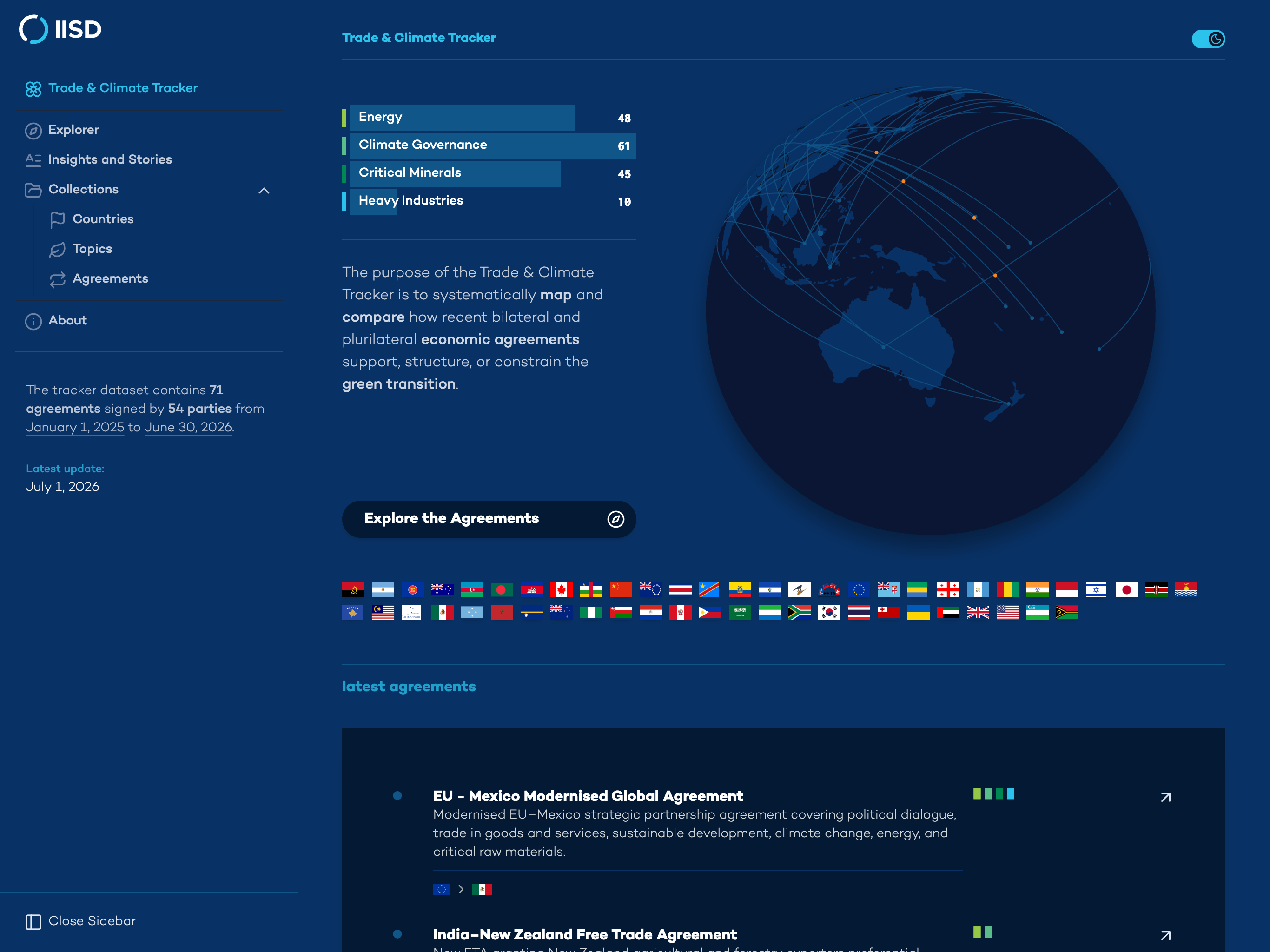
Trade & Climate Tracker
Mapping and comparing international trades agreements and their impact on green transition.
: https://iisd.org/trade-climate-tracker/
Governments are increasingly using economic agreements to cooperate on the green transition and enhance economic security and growth.
The Trade & Climate Tracker allows users to explore and compare the climate-related provisions of international trade agreements, and their potential impact on the green transition.
A proof of concept
The Global Strategic Communications Council (GSCC), a collaborative network of communications professionals promoted by Meliore Foundation, commissioned the development of a proof-of-concept platform to explore the potential of a digital tool for mapping and comparing climate-related provisions in international trade agreements.
The project is part of the broader work of the International Institute for Sustainable Development (IISD), a leading think tank on sustainable development.
Design & data architecture
The Tracker translates the domain knowledge of IISD's trade and energy experts into a structured, queryable dataset rather than a simple archive of agreement texts.
The tool is designed for comparative analysis and policy-oriented outputs. The primary unit of analysis is the agreement, regardless of whether the instrument is legally binding.
Each agreement is described with structured metadata — parties (countries, trade blocs such as the EU, EFTA or ASEAN), signature date, legal status, and type — so instruments as different as a binding FTA and a non-binding Memorandum of Understanding can be compared on equal footing.
A shared vocabulary for climate provisions
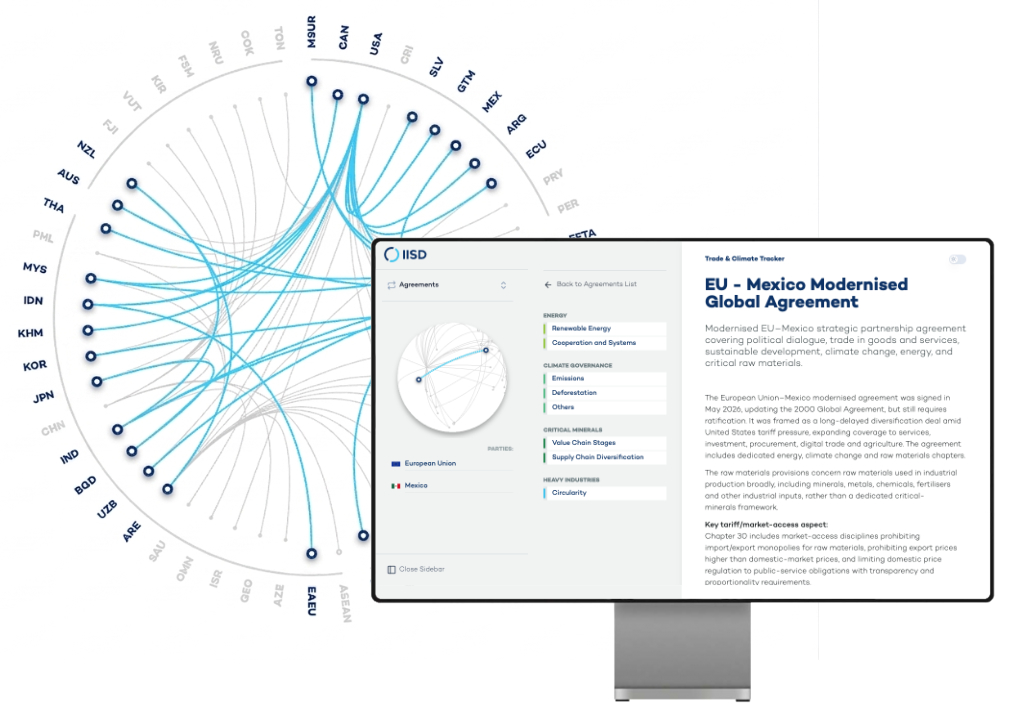
The central design challenge was finding a categorization of agreements meaningful to a policy audience. Working with IISD's team, we devised a two-level taxonomy organized around four broad areas — Energy, Climate, Critical Raw Materials, and Heavy Industry — each broken down into more specific subtopics, such as "Renewable energy" or "Cooperation and systems for energy".
A provision is coded only when it contains substantive operative content and may fall under more than one topic when it genuinely addresses several.
This double-tagging logic means a single agreement can legitimately surface under several topics at once, reflecting how real provisions often cut across energy, industry, and climate governance simultaneously — rather than forcing each clause into a single box.
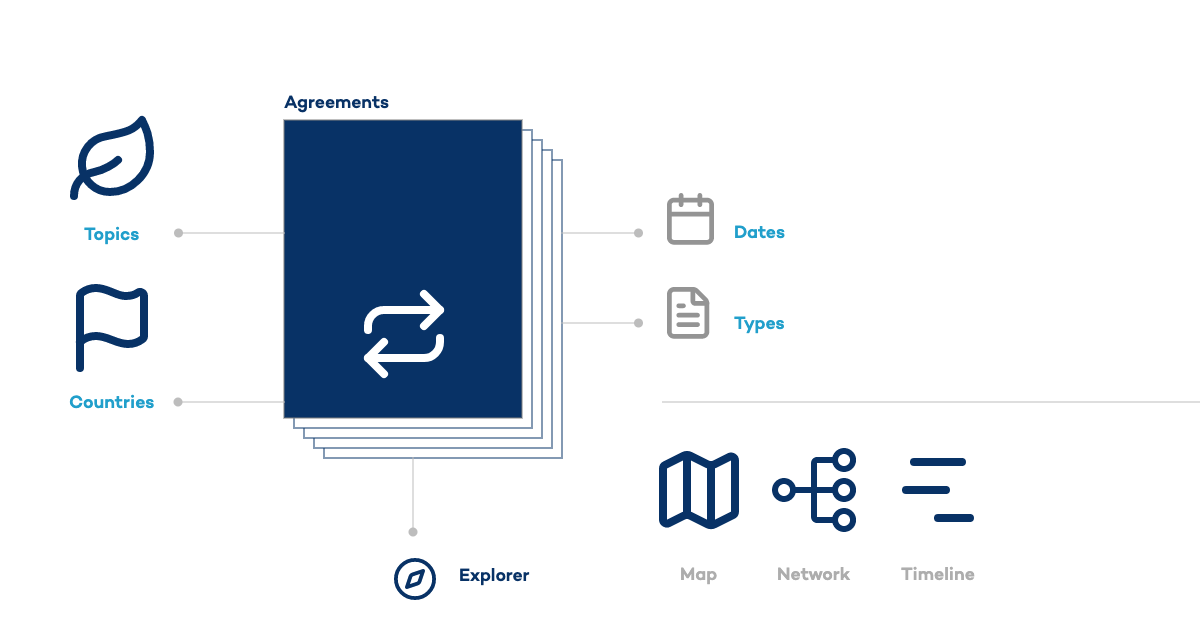
We assumed users would come to the Tracker with one of two questions in mind: what has been agreed on this topic? or what has this country signed?
Topics and countries are offered as the two main entry points for browsing, site-wide.
Content structure
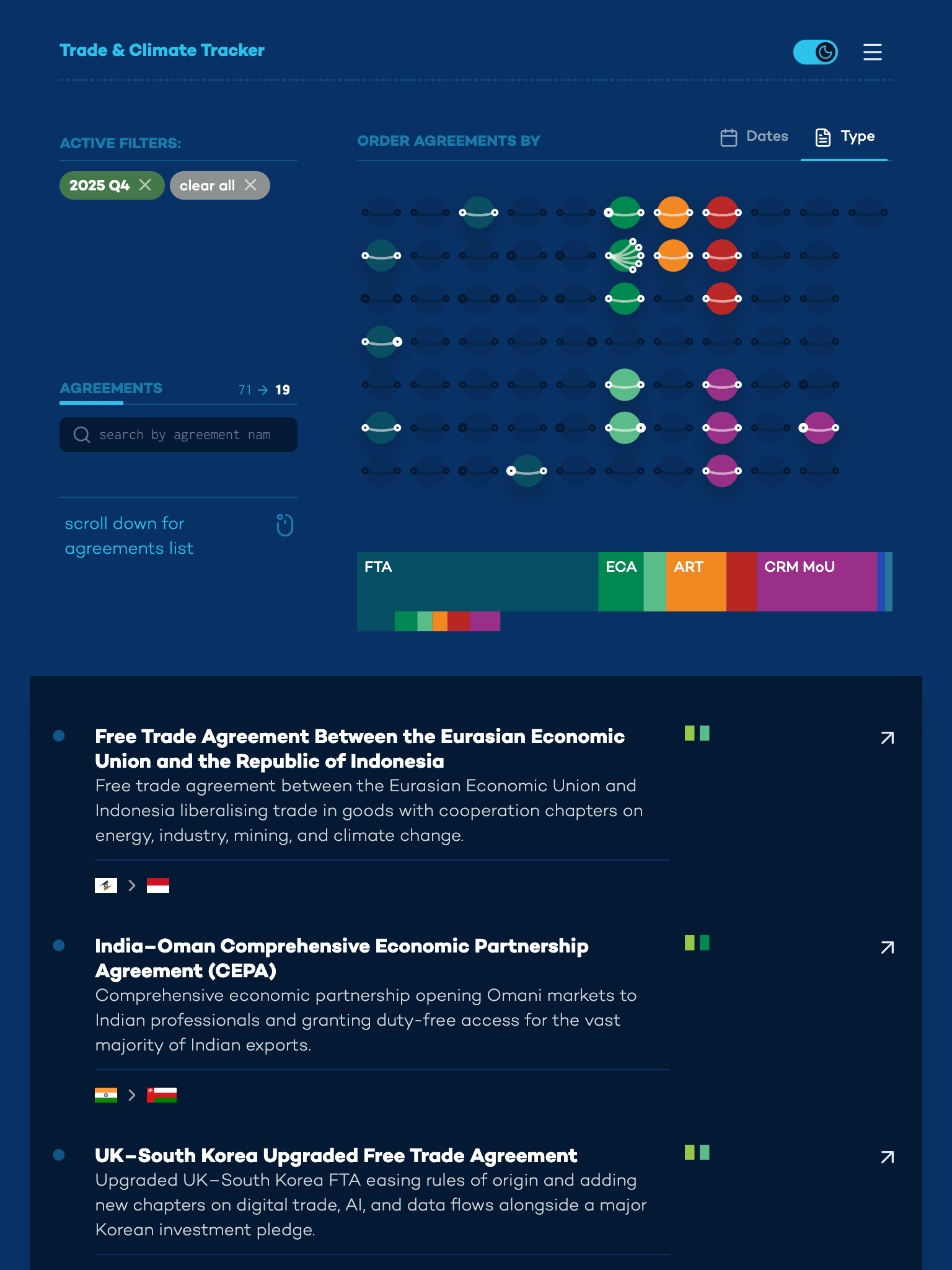
The part of the project that received the most design attention is the Agreements Explorer: a filterable interface that lets users slice the dataset by topic, country, dates, or type, and view the results as a map, a network diagram, or a timeline.
Alongside the Explorer, the site offers collections — curated profile pages for topics and for countries — plus a detail page for each individual agreement, and an institutional section (About, plus an "Insights & Stories" area) that situates the tool within IISD's broader work.
A social-media-friendly exporter
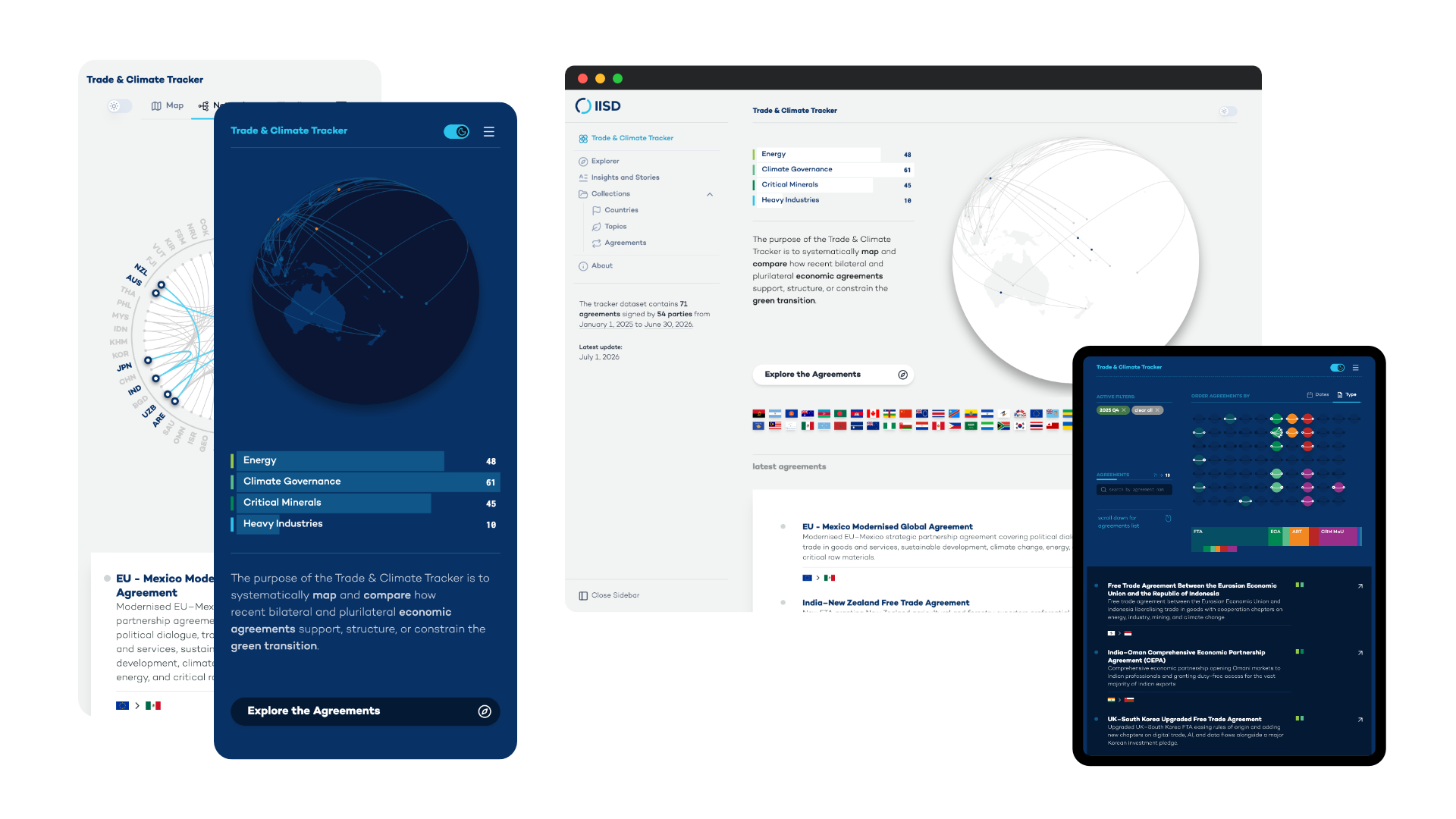
During review sessions, the visualizations built for the Explorer turned out to be one of the most compelling parts of the project in their own right — IISD asked whether they could be lifted out of the tool and used directly in their own communications, particularly on social media.
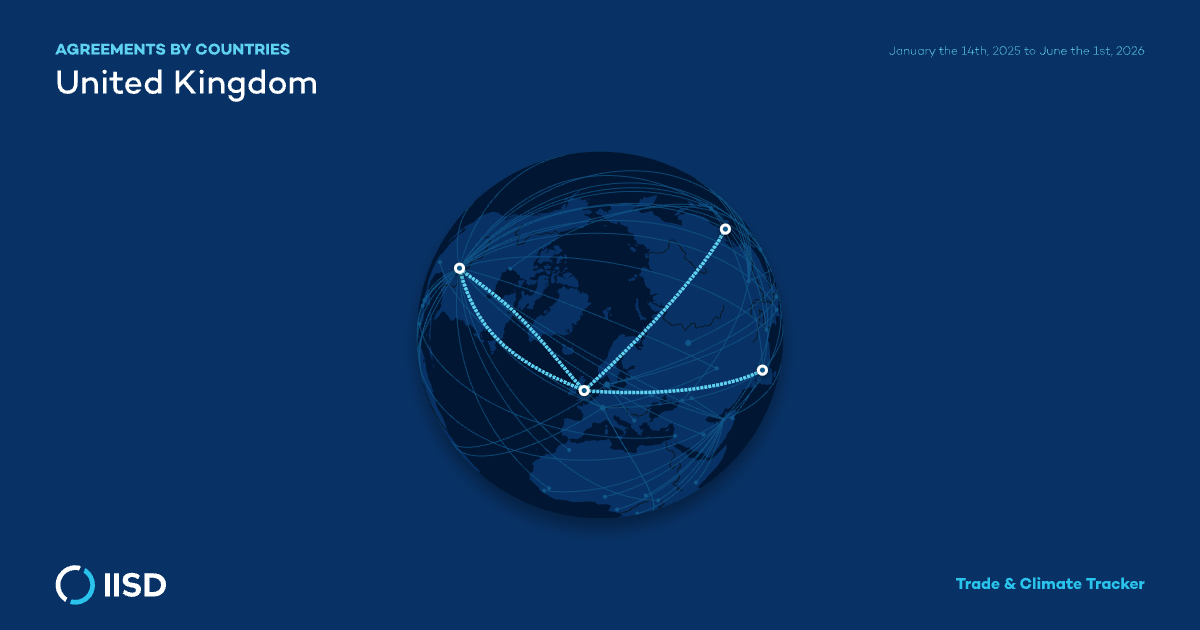
In response, we built a lightweight export feature: any filtered aggregation of the dataset — a topic, a country, a custom selection of agreements — can be rendered and exported directly in the standard formats used across social platforms (square, landscape, portrait, stories), showing one of the available map projections or a network diagram.
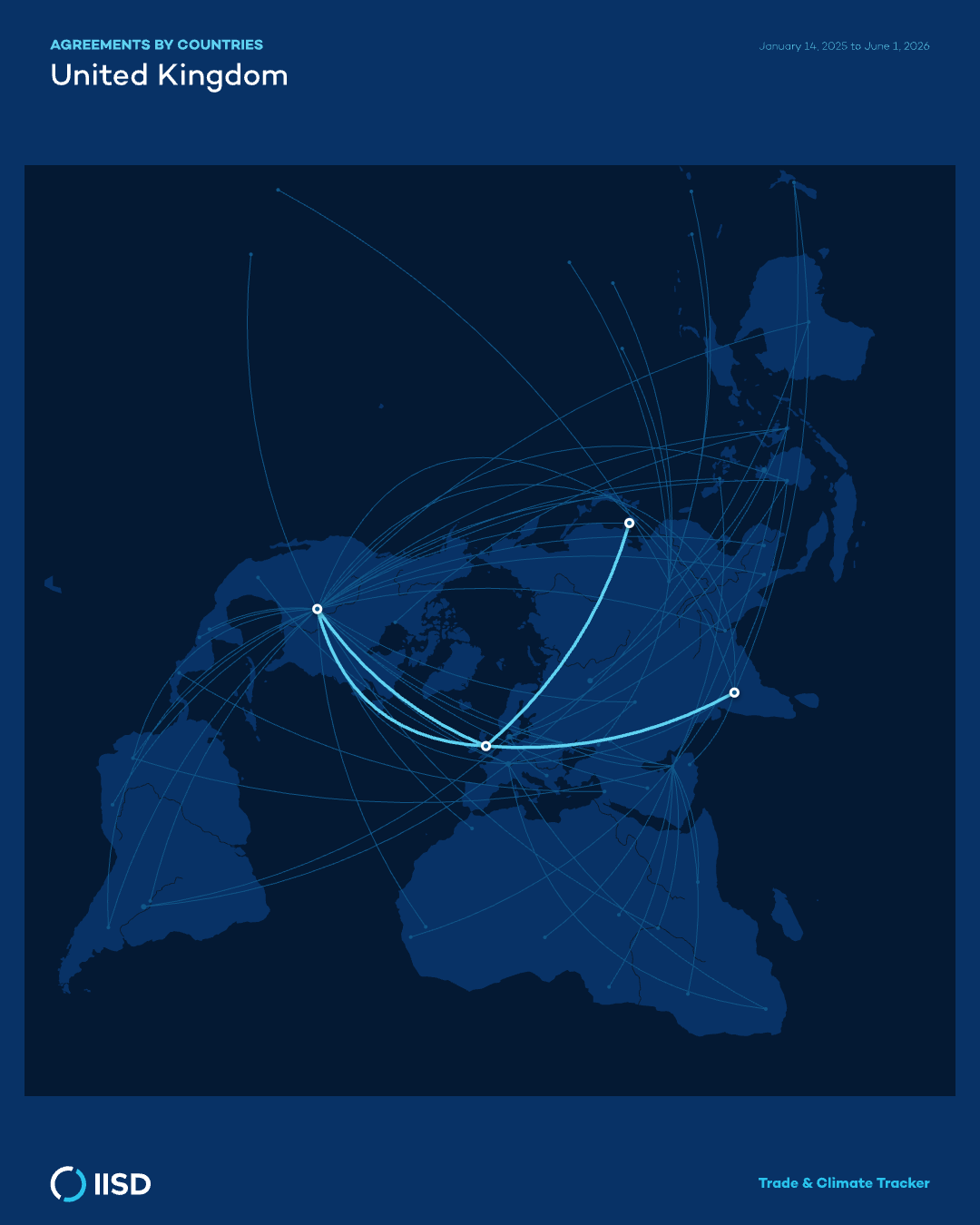
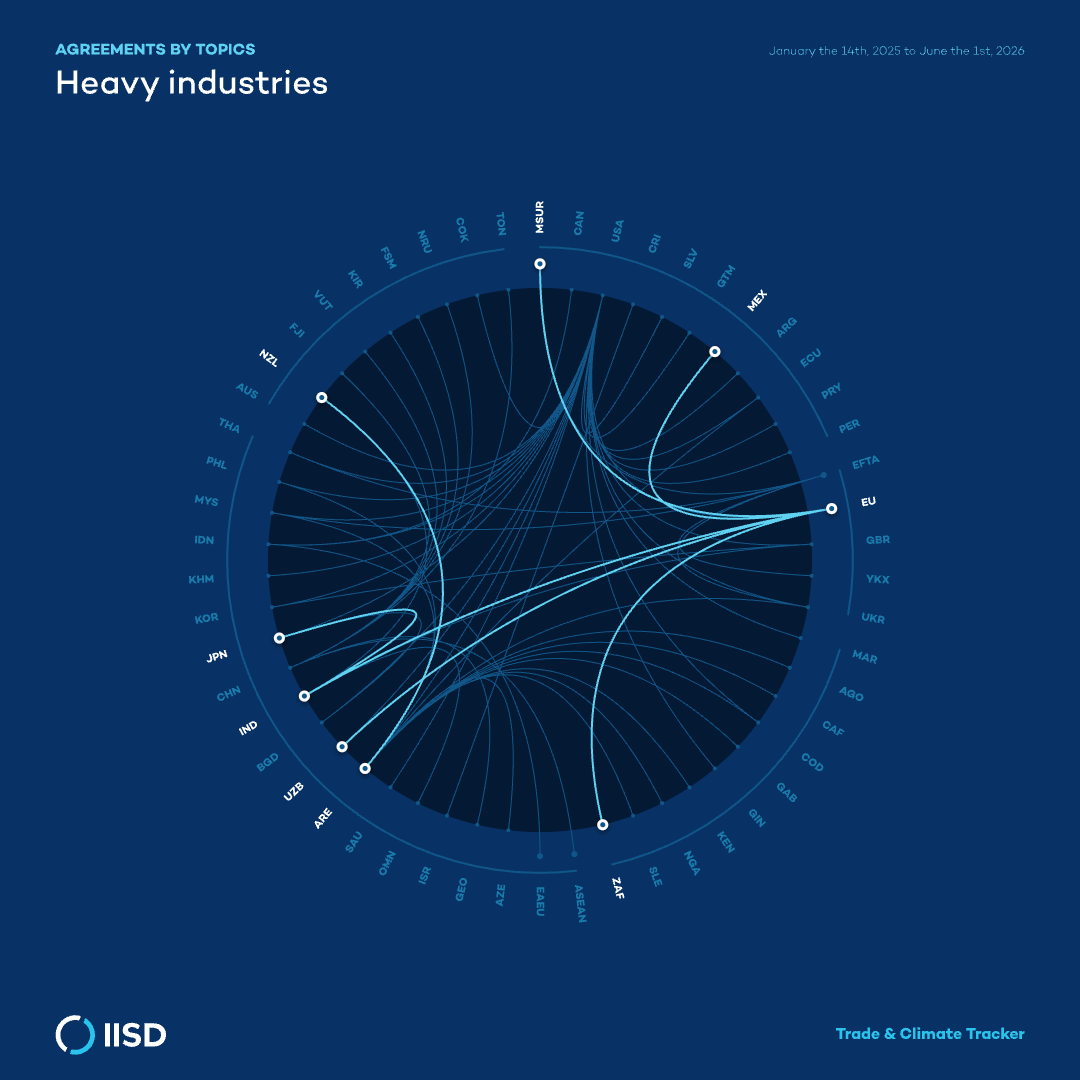
This turns the Tracker from an analysis tool into a small content-generation engine for IISD's communications team, without any extra design work required on their side.
Tech stack
This is a proof-of-concept stage, and the technical choices reflect that deliberately: no back end was implemented, and the whole project runs as a static site, built with Nuxt.js and hosted under an IISD subdomain. Structured data lives in CSV tables; verbose, narrative content is managed as a git-based collection of Markdown documents.
The result is a streamlined, low-overhead production setup — easy to stand up, easy to maintain, and easy to hand off — while still being architected to scale.
The clean separation between structured data, narrative content, and presentation means the same foundation can absorb a real back end, editorial workflows, or a larger dataset in future upgrades without a rebuild.